Showing posts with label drought. Show all posts

Tuesday, 10 September 2019

Current and future challenges for water resources management

I was recently asked to present on the current and future challenges for a water resources manager to address. We have seen a great deal of change and progress in how we plan for water resources in England over the last decade. This blog post summarises some of the key challenges I highlighted in my presentation.

Join the discussion as part of Theme 6 on Water Resources and Large Scale Water Management at the IWA World Water Congress in Copenhagen (October 2020 - see call for papers here).


Pressures on water resources

We face increasing pressures on water resources from climate change, population growth and the need to protect the environment. The latest summary of these pressures has been provided by the National Infrastructure Commission's 2018 report Preparing for a drier future: England’s water infrastructure needs. This sets out a 1 in 4 chance of serious drought between now and 2050 and that emergency options to address this could cost £40 billion vs £21 billion by taking a strategic approach. The Water UK Long Term Water Resource Planning Framework also highlights that there is an increasing risk of more frequent and intense droughts across England and Wales, not just in the South East.


Current challenges

Regulatory complexity and planning

We face a complicated policy and regulatory landscape when it comes to management of water resources. This is summarised by the figure below from Ofwat's Water 2020 report and since its publications there are further government policies linked to the 25 Year Environment Plan (e.g. biodiversity net gain) and new plans such as Drainage and Wastewater Management Plans that will have implications going forward for water resources management. Water companies face many tensions around meeting the objectives of Defra, Ofwat, the Environment Agency, CCWater and other government bodies. Additionally, the timeframes for planning are still not aligned.


In the latest planning period there has been greater consideration of the links between drought planning and long-term water resources management plans (WRMPs). An increasing level of complexity has been introduced into the water resources planning process. This is set out in the 2016 UWKIR report WRMP 2019 Methods - Decision Making Process: Guidance. Taking a risk based approach enables selection of the most appropriate methods for individual water companies. However, many of the more advanced processes may be less transparent and can be hard to communicate to customers and wider stakeholders. We need to keep sight of outputs and visualisations as decision making tools for planners and stakeholders to engage with, not as the ultimate output themselves. This was an issue I commented on in a blog post in 2016 when the WRMP guidance was published.

Resilience


Resilience to climate change and drought is a major factor in water resources planning. However, increasingly we are seeing the need for wider resilience to be addressed around changes to peak demand linked to hot weather. June 2018 was the driest June since 1925, with a rainfall total for England of only 15 mm. In England, United Utilities applied for a hosepipe ban, then called it off. In Northern Ireland a hosepipe ban was implemented for three weeks. In Scotland, the sustained dry weather and heatwave conditions in 2018 resulted in less water availability and an increase in customer demand. In some areas this was an additional 30% of demand and led to Scottish Water producing an additional 140Ml/d (Water Efficiency Strategy for the UK Year 1 Report).

The freeze-thaw incident of March 2018 resulted in more than 20,000 homes in London being without water due to pipe bursts and the wider impacts across the network of this increase in water demand. Many of the issues faced in terms of planning and customer engagement were similar to those that have been experience during times of drought. I wrote about this in a blog post for the WATEF network. What this incident highlighted was that many of the customer engagement lessons and recommendations from the 2012 drought had still not been implemented.

Competition and markets

In May 2019 Ofwat wrote to incumbent water companies and highlighted their desire to see development of more effective markets. These include developer services (e.g. self-lay networks), upstream water resources options and working with water retail companies who now supply non-household customers. Although water companies have released detailed information on their water resources requirements with their WRMPs there has been very little uptake by third party providers. Ofwat recently consulted on this "bilateral market" for water resources. Although we have had new appointments and variations for some time now, where an alternative water company to the incumbent can supply to a new development, this hasn't been as successful as in New South Wales in Australia where a similar regulatory regime has enabled new semi-autonomous water schemes within Sydney (see previous blog post).

One of the benefits of moving to retail competition for non-household customers identified in the Cave Review (2009) and the Water Act 2014 was greater levels of water efficiency. Research (link to report) early in the first year of market opening observed a limited range of services being offered. Ofwat's report on year 2 of the market highlights that "water efficiency measures has been slow to
develop":
  • Around 0.3% of customers who switched since market opening report leakage control services as a benefit of switching
  • Only 4% of customers who had renegotiated since market opening report water efficiency services as a benefit of renegotiating
  • "on the basis of customer interest and in view of a number of possible barriers to take up, that there remains untapped potential for continued development in the offer and take up of water efficiency services"
The ongoing challenge for water resources management will be working with retailers to enable demand forecasting as well as cost-effective options for delivering demand management in partnership (Water Efficiency Strategy for the UK Year 1 Report).

Regional water resources planning

In the lead up to WRMP24 a National Water Resources Framework group and further regional water planning bodies have evolved. Their aim is to (link to WRSE newsletter):

  • Develop strategic plans that set out each region’s contribution to the national need
  • Deliver ‘nationwide’ resilience – and greater ambition on metering, leakage, and options to lower demand and new transfers flagged as necessary by the National Infrastructure Commission (NIC)
  • Enable greater collaboration through more consistent planning approaches and by identifying and removing existing barriers. 

The link between regional planning and WRMPs wasn't always clear in WRMP19 (something highlighted by Ofwat responses to draft WRMPs - see examples). This was the case for options such as water efficiency, where joined-up programmes at scale could be more cost-effective. A major benefit of this planning approach will be working across sectors, such as with industry and agriculture. As with WRMPs there will be a need to engage with water retail companies also to ensure that non-household demand and water efficiency options can be considered at a regional scale also.


Future Challenges

Abstraction licence changes and catchment management

Abstraction licence reform is progressing with pilot catchments and a bottom-up focus rather than the legislative changes that have been proposed previously. By 2021 the programme aims for (see presentation at CIWEM Water Resources Conference 2018):

  • 90% of surface water bodies and 77% of groundwater bodies at the required standards 
    • RSA programme completed
    • 2,300 time limited licences reviewed 
  • 10 licensing strategies detail solutions for the most affected catchments (all updated by 2027)
    • Solutions to remaining environmental pressures 
    • Improving access to water
  • A new and consistent regulatory regime and a modern service
    • Clearer access to vital data (such as flows and licence details) 
    • Simpler processes
This will support water companies with licence trading, regional planning and flexible licence changes (e.g. during drought situations). Catchment management to address water resources quantity rather than just quality aspects will also be an area that may be picked up by regional planning approaches.

Demand management

Water efficiency

With common performance commitments as part of Ofwat's PR19 business planning process on water use, leakage and drought resilience there should be a greater business focus on demand management than in the past. The NIC report suggests 34% of the resilience gap can be met by demand management. However, this focusses on metering alone and there are still large savings that can be made through produce labelling, building standards and behaviour change programmes.

Defra are consulting on a range of measures including personals water consumption targets, incentives and smart metering. Water efficiency labelling combined with product standards and building regulations could reduce consumption by 30 litres per person per day within 25 years. Additionally, water companies need to engage with customers on climate change and population growth issues linked to rising consumption and to support working with them individually to help meet PCC targets. Smart metering is a key tool to provide the feedback on consumption to enable individual targets to support water company wide reduction in water consumption.

A recent experience of implementing water use percentage reduction targets can be seen in California. A report “Making Water Conservation a California Way of Life” identified that targets resulted in a 33% reduction in water use (Gallons per customer per day - equivalent to PCC).


Leakage

An average target for leakage reduction of 17% by the end of 2020-25 across all companies in England and Wales has been reported for PR19 draft determinations. This represents a significant challenge around technology and innovation to achieve this reduction, especially when the total reduction achieved in the last year was just 0.4% (Figures from WWT Databank, Vol 62, Issue 9). This is a major area of collaborative research focus in the UK via UKWIR with their strategic question "How will we achieve zero leakage by 2050 in a sustainable way?".

Transitions for resilience

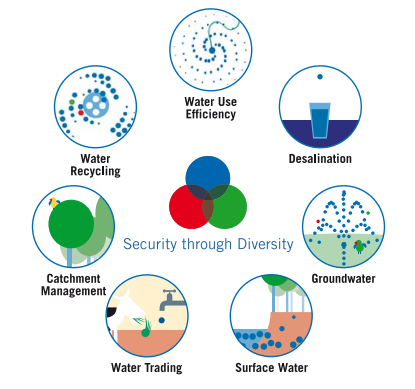
A new approach will be needed to support resilience to climate change, the wider pressures of population growth and the need to protect the environment. A successful approach to this has been applied in Western Australia using a security through diversity model. CIWEM's 2018 position on planning water resources recommends "Adoption of a ‘security through diversity’ approach to managing water resources":

"CIWEM advocates a strong commitment to the twin-track approach, moving towards a more
formalised ‘security through diversity’ approach. This should assess demand management
and new resource options alongside water recycling, water transfers and trading. These
options should be assessed on a long-term economic basis, taking full account of
environmental and social cost and benefit." 


The culture in water companies in relation to risk and innovation is steadily changing. However, in WRMP2019 many plans set out household and neighbourhood rainwater harvesting and SuDS options as being too risky to implement. We will need to see more examples of integrated water management in future. Smaller neighbourhood schemes can act as decentralised semi-autonomous nested supplies within our cities that can help address resilience issues and provide a transition between centralised and decentralised approaches. A good example is in North West Cambridge (link to video), however this is unique in terms of the university acting as a developer. Anglian Water and others are looking at how incentives through developer charges may support greater uptake of water reuse.


Links with business planning and customer outcomes

Increasing engagement will be required when developing plans and considering options (as has been the case across the last several price reviews). Water resources options, especially those based on demand management or integrated water management can have large impacts on CMeX and DMeX . Water companies will need to work across the business to deliver performance commitments and Water UK work on public interest.


Conclusions

I've outlined above some of the current and future pressures faced by water resources managers in England.

  • We are facing increasing pressures on water resources
  • There is increasing complexity of water resources planning and regional engagement
  • Transitions are required for resilient water supplies and wider sustainable water management (addressing flooding, water quality etc.)
  • These challenges are opportunities to improve outcomes for customers, the environment and business
Moving into PR24 there will be greater room for innovation in planning and delivering water resources as part of the wider social contract between water companies and customers. Water is a key medium through which we feel the impacts of climate change and recent declarations of a climate emergency need to take better account of this.

Join the discussion at IWA World Water Congress 2020

The call for papers, workshops, forums and training is open until the 30 October. Theme 6 is calling for papers on water resources and large scale water management, including:

Groundwater

  • Groundwater mapping, monitoring and modelling
  • Protection of groundwater quality and quantity
  • Soil contamination and groundwater remediation
  • Governance, management and institutional arrangements

Surface Water

  • Surface water monitoring systems and models
  • Protection of surface water quality and quantity
  • Source-to-sea pollution management
  • Pollution from point sources – agriculture, industry, urban
  • Diffuse pollution – sources and mitigation
  • Water-related ecosystems and environmental flows

Integrated Water Resources Management

  • Water stress, droughts and floods, including impact of climate change
  • Catchment management and ecosystem services on different scales
  • Large-scale nature-based solutions and biodiversity
  • Water rights, trading and partnerships

Holistic Assessments

  • Life cycle assessment, water efficiency, water footprint, virtual water, etc.
  • Planetary boundaries and science of sustainability
  • Water resource management towards Sustainable Development Goals (SDGs)

Find out more at: https://worldwatercongress.org/


Monday, 27 August 2018

Freeze/ thaw as a resilience issue linked to customer participation and water efficiency

Originally posted on WATEF Network 1/08/2018
https://www.watefnetwork.co.uk/blog-894


"We effectively faced a major drought occurring within the space of several days – we need to have much greater engagement with customers in order to deal with all resilience issues and water efficiency is a key aspect of this."

Background and impacts

More than 20,000 homes in London were without water in March 2018 due to an extreme weather event. Southern Water reported loss of supply to around 1,000 homes. Around 3,500 homes in Wales lost water supply and many parts of Birmingham, the West Midlands and Staffordshire (BBC News).

This network related event effectively led to the need for drought level responses. Londoners were told to “use as little water as possible” and to “take shorter showers”. Southern Water urged customers to “only use the water you absolutely must” (BBC News).

Ofwat recently released their report on the incident covering assessment, planning and preparation, handling of incidents, communications and support, and ongoing support. We’ve suggested it should also look at the role of water retailers in working with customers and wholesale companies during this period. Research by the Consumer Council for Water (CCWater) in seven of the worst affected areas indicates that 40% of customers impacted received no communication from their water company during the incident. They identified better performance by those companies who actively communicated with local resilience forums in advance.


Although water companies are moving beyond just being in contact with customers when there is a bill or a problem, this incident further illustrated the need for greater effort in this area if we want customer “participation” before and during resilience incidents.

This blog post sets out out thoughts on communications and support and proposes that the problems in this area reflect wider industry issues, which this intense resilience incident could have benefitted from: 

  • A much closer relationship with customers could enable a better understanding of vulnerable users but also how to help/encourage them to prepare, and then to provide support to them.
  • Greater communication up-front and behaviour change could protect pipes/ reduce water use
  • Increased and sustained baseline communication on water resources, networks and how to save water could enable more effective customer participation during future resilience issues. Water efficiency was a key message to reduce demand from the system in order to maintain supplies.

Moving towards customer participation

The Waterwise Water Efficiency Strategy for the UK highlighted that consistent and co-ordinated messages are important for effective communication and vital to developing a water-saving culture. But there is a lack of consistent messaging and little coordinated or collaborative action between water companies. The 2012 drought highlighted the importance and benefits of having joined-up messaging across the sector (as did the recent freeze-thaw incident).


How does this link to the 2012 drought?

There are many lessons that can be learnt from the 2012 drought that apply to future drought (which has been looming recently in the South East of England) or other resilience issues.

Some of the key findings from a Waterwise and WWF report relevant to this event are: 

  • Joint working and messaging was really important during the 2012 drought – how could this have been better coordinated by water companies in the freeze/thaw event, particularly in London?
  • Having agreed messages and a single point of contact helped in the 2012 drought – can we have these prepared in advance for a range of future resilience issues?
  • There was a lot of stakeholder engagement by the industry, however this was starting from a fairly low base with many sectors and there is a need for much earlier and better stakeholder engagement by the water industry – this finding reflects the low level of ongoing engagement around water resources in general and addressing this would help in the freeze-thaw also. Engaging with resilience forums is a key action suggested by Ofwat.

  • There is a need for quasi-Governmental bodies to play a larger role in engaging with the public on wider water issues, these include bodies such as the Met Office, British Geological Survey (BGS) and the Research Councils – how could these bodies have helped with forecasting and communications during the incident?

  • Despite the company activity the customer research shows that people perceived the reason for the drought to be water company leakage. This highlights that there is a need to increase general knowledge around water, as there is a lack of understanding of water processes amongst the public – a survey following this incident may also find a lack of understanding of water networks and that there is some baseline risk that can’t be prevented. How can this better be communicated?

  • There clearly needs to be a national ongoing campaign to promote water issues and water efficiency, so that there is a background of understanding in advance of the next drought – this ongoing communication would help as customers would already be engaged during resilience issues.

  • Water companies should look at the option of using mass media such as television or direct mail during future droughts which would enable them to provide more in depth information about the hydrology of the drought. There is a lot of academic research that shows the potential for instilling pro environmental activity through normalised behaviour. However this requires a baseline of understanding and more information than is currently provided, the current information on water resources and water efficiency is passive and there is a need for proactive provision of information – it will be really important to understand the most effective modes of communication on an ongoing basis but also during resilience events. It shouldn’t just be social media.
 A review undertaken for UKWIR on understanding the impacts of temporary use benefits identified:

  •  There was a missed opportunity in terms of wider collaboration. For instance Thames shared its copy and images with other water companies but the use of other logos on the images (other water companies, Met Office, EA, and NGOs) would probably have added credibility and showed that this was a wider issue - how can water companies engage with other trusted bodies during resilience events? Should there have been communications at the city level in London, for example?
  • There urgently needs to be a well-resourced and constantly updated industry source of information on water resources (this could be web-based) – this communication would help ongoing customer engagement and participation.
  • Television was the primary source of information on the drought for customers, however clear and concise geographical splits should be communicated through the media to explain where TUB restrictions are imposed – this finding supports the need for mass communication, which is something water companies held back from during this incident.
  • Water companies should notify those non-domestic sectors that might be affected by potential drought restrictions as early as possible – customers would prefer to know if they are going to be affected, however some water companies didn’t communicate early or the extent of the problems as they didn’t want to cause panic. Water companies need to better understand the desires of their customers for communication during these incidents.
  • Water company websites, although not identified as a key source of information, saw a huge upturn in visitor numbers during the TUBs. Messages and access to further information should be easily accessible from the landing page of the website, and data should be updated on a regular basis (even outside of drought periods) – we know that some water company websites couldn’t handle the number of visits during this incident and this needs to be reviewed.

What can we learn for water efficiency and what research may be useful?

Although this was an extreme incident that happened in a short amount of time it does raise questions about the industry’s overall engagement with customers and the ability to deal with a more prolonged incident such as drought effectively. Many of the recommendations from the 2012 drought haven’t been taken forward, however Waterwise and our Leadership Group on Water Efficiency and Customer Participation is looking to take forward a national communications platform that could help with longer term customer engagement.

Some key areas for research to support future resilience incidents linked to water resources are: 

  • Customer survey on communications methods and channels before, during and after the freeze/thaw incident. This should use a similar approach to the CCWater and following UKWIR surveys used to understand impacts in the 2012 drought 
  • Segmentation and customer research in order to target messaging about water efficiency, preparing for freeze/thaw by lagging pipes and opening valves etc
  • Research on developing communications and utilising national platforms to enable customers to participate in reducing demand over the long term, responding during an emergency and to help them work with water companies to get water when supplies are cut off
  • What are the roles and responsibilities of retailers for supporting water customer resilience?

Waterwise are working with stakeholders across the sector to answer these question in delivering our Water Efficiency Strategy for the UK.


Wednesday, 29 June 2016

Water Efficiency in Cities - indexes, benchmarks and metrics

Efficient urban water management is essential to meet the challenges of climate change and population growth. By 2050, 86% of the population of OECD countries will be living in cities (OECD, 2014). Water efficiency and water conservation is an integral part of this. There have been several recent indexes produced of sustainable cities focussing on water management. In this blog post I outline the results in relation to water efficiency and how we might be able to improve indicators in this area. The International Water Association Efficient Urban Water Management Specialist Group is also currently assessing examples of best practice and new indicators to benchmark cities and utilities.

Sustainable Cities Water Index 2016

Released in May 2016 the Sustainable Cities Water Index was produced by Arcadis and the Centre for Economics and Business Research. A sub-index was produced for efficiency and this is illustrated below. The index focusses on efficiency and controlled management of water and is built up from seven indicators. In this study Copenhagen ranks highest linked to one of the lowest rates of leakage, relatively high unit charges for water and a high proportion of metered supplies.

Of interest from my perspective being based in London is the relatively low score for UK cities of Manchester, Birmingham and London. These low scores are linked to low levels of water reuse and water metering.

Sustainable Cities Water Efficiency sub-index 2016

The table below outlines the indicators used in the efficiency sub-index and the sources of data behind them. A weighting is applied to the indicators also in calculating the total scores for cities.


City Blueprint Framework and Blue Cities Index 2015

An EU initiative has been developing a City Blueprint Framework, which was initially applied to 11 cities in 2013 and expanded in a Horizon 2020 project to cover 45 municipalities and regions internationally in 2015. This framework recognises the unique nature of the social, financial and environmental setting of each city and applied this in the choice of indicator. An example give is that limited natural water availability in semi(arid) regions may result in a low score for water stress while the city may be a frontrunner in water efficiency practices. Measuring urban performance to reduce water consumption is outlined as a fairer comparison between cities.

The following indicators relate to water efficiency directly (see paper assessing these):
  • Infrastructure - water system leakage (based on percentage leakage)
  • Climate robustness - drinking water consumption (total consumption for a city m3)
  • Governance - water efficiency measures
A map of the Blue Cities Index results is provided below. This shows the highest scores in Europe, medium scores in the UK, Australia and North America and lower scores in developing/ transition economies. 

Blue Cities Index 2015 (Koop and Van Leeuwen)


Further details on specific indicators and scores for cities are available in several reports online. The average water efficiency score in the latest assessment was 7.9 on a scale from 0 to 10. Water efficiency is core to the narratives around rankings for blue cities. For example, a score of 4-6 is a water efficient city, 6-8 a resource efficient and adaptive city, and 8-10 a water wise city. No city has achieved water wise city status to date and London is ranked as a resource efficient and adaptive city with a score of 7.1. Leakage rates varied from 2% in Berlin to 60% in Varna with an average of 21%


Water Sensitive Cities Index 2016

The Water Sensitive Cities Index is another approach currently in development and that has been trialled with several cities in Australia and Asia. The index is designed to:
  • Benchmark and rank cities based on water sensitivity performance
  • Set targets and track progress
  • Inform management responses to improve water sensitive practices, to enable the transition to a water sensitive city
  • Forster industry collaboration

A demonstration portal is currently live (image and link below). This includes several Australian cities and others in the region. The demonstration scores currently rank Australian cities as Brisbane, Sydney, Melbourne, then Perth for being water sensitive.

Melbourne Project Demonstration of the Water Sensitive Cities Index 

The indicators behind the assessment are included in the table below. Of these water efficiency relates to many of the broader governance indicators. More specific indicators for water efficiency include, low end user potable water demand, low GHG emission in water sector, diversified self sufficient fit-for-purpose water supply, and integration and intelligent control. 

Example indicators for Water Sensitive Cities Index (Chesterfield, 2015)

Alliance for Water Efficiency State Scorecard 2012

In 2011 the US Alliance for Water Efficiency surveyed 50 states to identify and assess water conservation laws and policies. The survey included 20 questions and each was scored qualitatively for the state. These ranged from 1 point for answering if there is a state agency in charge of drinking water conservation to 3 points for robust water loss regulation and policy with targets across all suppliers.

Scores were then translated into a grading scale of A to D with A+ being the highest score and D the lowest. The results are mapped below and this study usefully outlined the variation in policy across the country. A detailed policy analysis is also included in the report along with a follow-up report based on public comments and dialogue generated by the results.
Assessment of water conservation policies USA 2012

Water Conservation Measurement Metrics 2009

In 2009 the American Water Works Association funded a study to provide guidance on standardised methods of calculating metrics and to outline the advantages and disadvantages of these. The study utilised data from seven US water utilities to illustrate the appropriate use of metrics. Some of the key data and metrics that may be used within wider benchmarks and indexes are outlined. In particular the authors provide a detailed assessment of the advantages and disadvantages of metrics of aggregate water use such as per capita production, sector specific water use, annual and seasonal water use. 

Due to the variation in environmental and social factors experience by different utilities it was suggested that only ratio based indicators similar to the IWA infrastructure leakage index (ILI) would be appropriate. An indoor conservation index (ICI) formula is proposed based on the ratio of current intensity and presence of end uses. A total of 23 metrics of water use and conservation are presented and discussed.


Indicators for Water Efficiency

Based on the elements of water efficiency within the indexes above it is clear that there is a wide variation in current performance and the opportunity for many cities to improve. This supports the need for a higher resolution analysis of water efficiency specifically for cities, utilities and states/ countries. An assessment of this type could also support discussions on best practice, knowledge sharing and provide potential approaches to transition from low levels of water efficiency to higher levels of water efficiency. This is particularly important from a resilience perspective to address the pressures from climate change and population growth. Also, a joint qualitative and quantitative approach may be needed for this area.

A water efficiency index could include indicators such as:
  • Leakage - using indicators such as the Infrastructure Leakage Index
  • Water efficient behaviours
  • Smart metering
  • Carbon emissions from water use
The IWA Efficient Urban Water Management specialist group has identified the need to collate evidence on water efficiency projects to support such an index. Although there have been several decades of progress in this area there are few collations of this evidence, excluding the Waterwise evidence base in the UK and the Water Resources Group 2030 managing water scarcity catalogue.


Sustainable and integrated water management

Many of the index approaches are moving towards an integrated view of water management. However, the direct links between different indicators aren't often made and there is the potential for less sustainable outcomes where desalination and water reuse capacity score highly but may have a higher carbon emission potential than other options. Indexes are useful for providing a comparison between cities and starting dialogue, however more detailed approaches are needed to consider social, environmental and economic trade-offs. One way of looking at this is in terms of resilient pathways:

"Resilient pathways will simultaneously reduce GHG emissions, lower overall water demand, maintain overall environmental quality and allow living standards to continue to improve"

Water efficiency measures can deliver benefits for adapting to climate change but also mitigation benefits, especially when considering emissions from heating hot water. As we integrate water management we need to ensure that the evidence and knowledge base on water efficiency is taken forward also.

Tuesday, 31 May 2016

Communicating Drought

The UK experienced major flooding in the north of England in 2015 that followed on from winter storms and wider flooding in 2013/2014. This explains the current focus on flood risk management. However, think back to 2012 and during the London Olympic games there were temporary use bans (hosepipe bans/ watering restrictions) and a real potential for needing further measures to guarantee supply to customers. Even with heavy rainfall the impact to groundwater levels meant that these watering restrictions remained in place for some time. With greater hydrological extremes occurring due to climate change we need to prepare for drought as well as flooding.

Example advertising from Thames Water during the 2012 drought (Waterwise and WWF, 2013)

Jamie Hannaford from the Centre for Ecology and Hydrology presented to the Chartered Institute of Water and Environment (CIWEM) Water Resources Panel's May 2016 meeting on "Improving drought information for decision making" and the recent research research funded by NERC and other research councils. Water companies are currently updating their drought and water resources management plans - this provides an opportunity to consider and test new approaches to communicating drought risk to customers and using this to support water efficiency efforts.

 Below I reference several recent research projects in the context of how can we better communicate drought?

Monitoring and communicating drought

The 2012 drought was the first time that a new range of Temporary Use Bans were implemented. I worked on a project for UK Water Industry Research to understand the impacts of these restrictions on water use both qualitatively in terms of customer views and quantitatively in terms of water use (see presentation for CIWEM Annual Conference 2014). Although the impacts of water use were hard to statistically support due to the timing of the implementation with heavy rainfall and flooding, there was a clear message from businesses and households that they'd like better communication in the run-up to a drought. Earlier communication around the drought led to some water company customers having a better understanding of the issues and potentially supported reduced consumption (UKWIR Report).

The DRIVER project is assessing monitoring and early warning systems in the US, Europe and Australia. Some examples of these approaches are provided below and include indicators of drought beyond communicating groundwater levels or river flows as currently practised in the UK (see monthly hydrological summaries).

Examples of drought monitoring and early warning systems (Hannaford, 2016)

A UK Drought Portal is now being produced using various standardised indexes of precipitation, evapotransporation, streamflow and groundwater levels. These enable communication of drought at a higher resolution and easier comparison between different parts of the country. This will soon be updated with 'live' monthly data. A drought portal brining together data sources could also address a criticism from communications during the 2012 drought around the need for water companies to use bring together wider datasets in communications (see Waterwise and WWF report).
CEH UK Drought Portal 
Part of the research is assessing how the indexes can be linked with drought impacts and decision making by government and water companies. However this could also provide an improved communication tool for the public. Businesses are increasingly looking to monitor climate change risks and drought can have significant impacts. 

A recent report on "Managing Drought: Learning from Australia" was published by the Alliance for Water Efficiency, Institute for Sustainable Futures, and the Pacific Institute. A key finding of this report was "Clear, credible communication about the drought situation and response is paramount to public participation and support". This highlights the need for multi-modal communication on both water storage levels and water savings. Australian utilities produce daily figures of water availability for the media/ government (example below) and this information was important to support community awareness and social marketing approaches to change water using behaviours. This is supported by a Waterwise and WWF report on the 2012 UK drought suggesting that drought communications would have been easier with a higher background level of demand-side knowledge amongst the public. 
Water supply and demand data Water Corporation 27 May 2016

The UK could benefit from improved communication of water use linked to water availability. Although the Drought Risks and You (DRY) research project includes an element of demand through a community water use survey, more research is needed on the potential drought monitoring communication to support improved implementation of water efficiency measures during the next drought. A lack of sufficient demand monitoring hindered the ability to determine any statistical reduction in water use due to hosepipe bans during the 2012 drought. There is also a lack of comparability between water company datasets due to varying availability of occupancy data, socio-economic classifications, and standard industry classification for non-domestic use.

Going forward another area to consider is communicating both drought and flood risk to households to support integrated water management actions. For example, rainwater harvesting either through use of a water butt or a fully plumbed system can have benefits during flooding and drought events. Better communicating the risks may support incentive programmes around improved water management in buildings also.

Monday, 15 February 2016

Water resources management planning guideline: greater flexibility or more complication?

This is an adapted version of a blog post co-authored with Sandra Ryan

Managing water in the UK is a juggling act. Devastating floods grab our attention and focus thoughts on how we can adapt to conditions plunging our communities under water. It seems strange but at the same time we must prepare against the chronic water supply shortages that a changing climate, growing population, and environmental objectives threaten. While flooding hits the front pages, the behind the scenes work to secure water supply in the long-term continues.

On that note we responded to the Environment Agency on its proposed changes to the Water Resources Planning Guideline (Jan 2016), the document which sets out the essence of how water companies are required to develop their long-term plans. The Environment Agency has slimmed down its guidance document, a step which reflects the Government’s preference to regulate with less prescription. We comment on how well the new guidance supports water companies to prepare robust plans at a time when so many priorities are changing and different approaches are up for grabs:


  • Major shifts in climate that mean our traditional water resource and supply systems are less reliable mean that we need to re-think our whole approach to describing the problem and assessing the value of different types of solutions. Resilience is a key concept developing in water resources management plan 2019 (WRMP19), however this needs further definition for planning. Flexibility to respond to abrupt problems from malicious attacks to flooding of water supply infrastructure should be recognised as a core aspect of a resilient system.
  • While extreme flooding hits our communities with increased frequency, more intense dry periods and extreme droughts are also expected. A recent report for the Environment Agency, ‘Performance of Water Supply Systems during Extreme Drought’ outlines how water companies can test how much ‘drought’ stress their supply systems could withstand, whether they are vulnerable to rapid failure, progressive failure, or have a low risk of failure to extreme drought that could become the new normal. 
  • Nobody likes excessively long documents and slimmed down guidance initially seems like a good outcome. However, useful advice such as clarifying proportionate planning activity in relation to scale and severity of potential water risks, has been removed, and detailed information on methodologies has been replaced with report references. Reliance on referencing UK Water Industry Research reports may compromise the understanding of stakeholders without access to them.
  • The Ofwat Resilience Task Force has suggested linking long-term water resource planning with wastewater asset planning, wider integrated water management, managing flood risk, drought protection, and water quality at the catchment scale. Fully embracing integrated planning offers many benefits in terms of the quality of outcomes and efficiencies in the planning processes.
  • We’re very pleased to see that the planning approach has taken the leap to accepting that making decisions based on ‘least-cost planning’ may no longer be the best way to manage complex systems. However, the content of the new guideline remains rooted in implicit assumptions that companies will continue to plan in the traditional way, focussing on forecasting to narrow down the scope of the problem, rather than developing solutions that offer flexibility to respond to the inevitable uncertainties of the future. The new planning guideline and tables that need to be completed for submission suggest that a traditional deterministic least cost plan will still need to be developed along with more any new probabilistic alternative decision making assessments (we will outline these in a future blog).
  • Water companies will be required to provide the rationale for their choice of decision-making approach (eg least-cost planning, robust decision making, real options appraisal etc) to help regulators and customers understand the underlying factors driving investment decisions, and ultimately customer bills. This needs to set out the similarities and differences between alternative decision making approaches and least cost planning.

Wednesday, 9 December 2015

COP21 Intended Nationally Determined Contributions and Water


We are now heading towards the end of the COP21 climate change negotiations in Paris. However, I thought this is still a good time to bring up the issue of water and climate change. Water is a key medium through which we feel the impacts of climate change but also a key driver through carbon emissions from treatment, use and disposal.

In 2014 I worked with several countries including Azerbaijan to consider water sector emissions in their Intended Nationally Determined Contributions (INDCs). These were designed by the UNFCCC to encourage countries to consider their domestic mitigation and adaptation measures and communicate these ahead of the conference (the figure below from the UNFCC portal show the progress of submissions to date).

This post outlines case-studies on water and climate change and provides a link to a work in progress document collating water sector actions in submitted INDCs.

Submissions to date
INDC Submissions to date

Water sector INDCs - Azerbaijan Case Study

I was invited by the European Commission funded ClimaEast project to present at a National Workshop on Water-related Policies and Measures as part of Intended Nationally Determined Contributions. In my presentation I covered:
  • Water sector energy use and carbon emissions
  • UK research identifying 90% of emissions from water supply, use and disposal are related to heating hot water in the home
  • UK research identifying that demand management options can have lower carbon costs than large centralised supply options
  • Australian example - heating hot water in the home accounts for 8% of Australia's GHG emissions, 13% of electricity use, and 18% of natural gas use
  • Case studies - South East Water; joint water and energy efficiency programes; Water Sensitive Urban Design
  • Irrigation and agriculture dominate water use in Azerbaijan, however water recycling is increasing. The carbon emissions from this sector needed further assessment.
Water sector carbon emissions in a city

Review of INDCs and Water

The UNFCCC has published the INDCs submitted by each country. I've been updating a google doc with water sector actions. The aim is to collate this information for further review and it can input into projects such as the International Water Associations Water and Climate Change WACCLIM initiative for utilities and how this links to city, national and international climate change agendas.

Some of the key messages on water in INDCs include:

Developing the Ministry of Water and Irrigation’s (MWI) Energy Efficiency and Renewable Energy Policy for the Jordanian Water Sector (2015) starting with utilization of sludge and other biosolids to generate energy, which is one of several projects announced under the policy, which seeks to achieve a 15 % reduction in energy consumption of billed water by the year 2025 through the introduction of economically feasible and environment-friendly power generation systems based on renewable energy sources.  Introducing renewable energy as a source to supply water systems. (Jordan)

Water resource management tools, which include climate change and variability considerations, will be in place for the country’s priority water basins (Columbia)

The initial costing of implementing the green growth and climate resilience strategy indicated that Rwanda will need 24.15 Billion USD in the sector of Water resource management, Agriculture and Energy up to 2030 (Rwanda)

Singapore has developed a robust, diversified water supply system through “The Four National Taps”: namely, local catchment water, imported water, NEWater7 and desalinated water. Since 2011, with the completion of three reservoirs in urbanised areas, the total water catchment area has been increased from half to two-thirds of Singapore’s land surface. (Singapore)

Guarantee the integral management of water for its different uses (agriculture, ecological, urban, industrial and domestic). (Mexico)

Tonga’s current reliance on imported oil for its development needs, which supplies all transport fuel, much of the energy for water pumping. The Government also aims to replace all diesel-based water pumping engines by 2017 using solar power. (Tonga)

Please contact me if you have any suggestions for this or are interesting in helping collate and assess water related INDC contributions.

Working together to identify climate change vulnerabilities (Bursa, Turkey)

Tuesday, 1 September 2015

Planning for drought

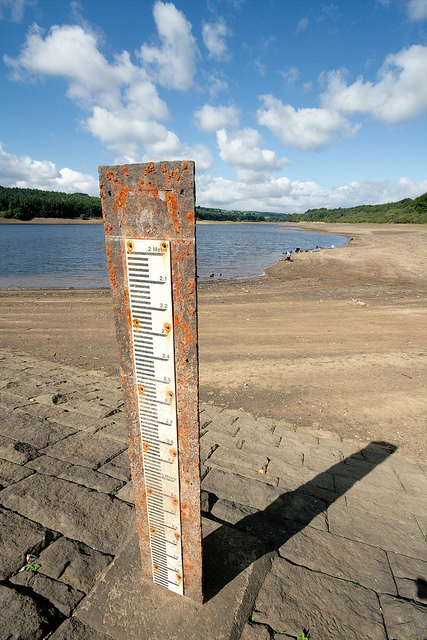
4952839239_7573d99134_z.jpg
The Environment Agency in England recently consulted on water company drought plan guidance. In the UK this framework is continually evolving and supported companies during the 2012 drought along with efforts to increase longer term resiliency. In this blog I comment on this guidance and ask how we can better integrate water resources planning and drought planning?


Long term planning
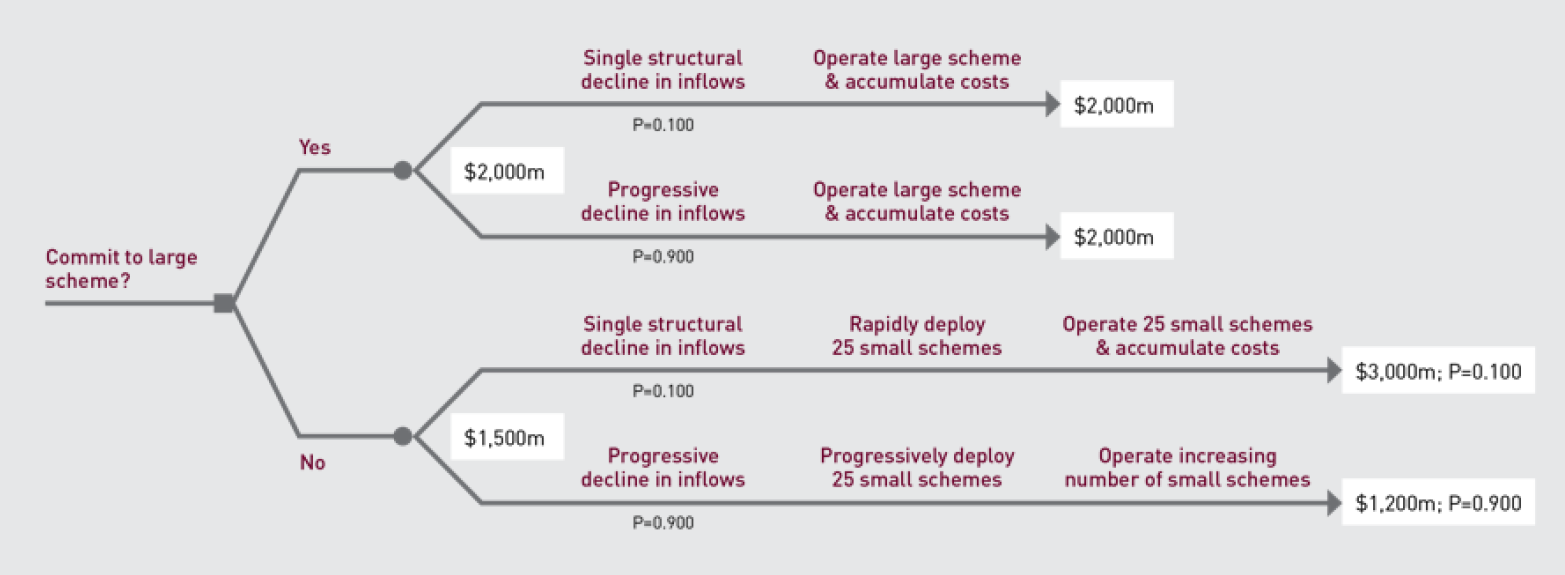
Better integration is required between drought planning and water resources management plans. A real options analysis approach as part of water resources planning can support development of incremental measures to address the more extreme droughts that we expect with climate change. An example of this approach was presented for Sydney by Stuart White at the International Water Association Efficient 2015 conference (Figure below), whereby a significant costs saving would have arisen through planning for and not building a desalination plant. Similar approaches have already been applied in the UK such as the Thames Estuary 2100 project.


Real Options Analysis approach applied in Sydney, Australia (White, 2015)


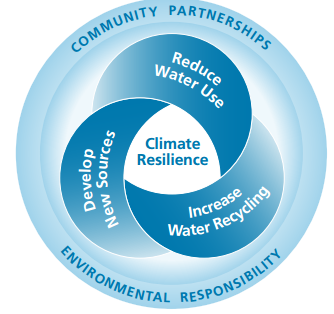
This was also my experience working for the Water Corporation in Western Australia during what was at the time the driest year on record (2006). As part of our drought response we utilised a detailed Integrated Resource Planning model to develop short and long term demand management behaviour change programmes to meet the gap between new supply options. Additionally, a broader portfolio of options as part of a “security through diversity” approach was important in enabling Western Australia to have lesser watering restrictions than other states. This has now developed into climate resilient planning. Having a suite of water resources options available as part of drought planning can help in the event of future extreme drought beyond what we traditionally plan for.


Resilience approaches
Resilience is increasingly being recognised by the economic regulator Ofwat and the Environment Agency as essential in the water sector. This was recently defined by an Ofwat task and finish group as:


Resilience is the ability to cope with, and recover from, disruption, and adapt to, trends and variability in order to maintain services for people and protect the natural environment now and in the future.


Resilience is also increasingly a theme for cities in the UK and is being explored as part of the 100 Resilient Cities programme. The interaction between the regional scale drought management responses of water companies and city scale actions need to be considered. This links to land-use planning where decisions on water management for new developments can have a significant impact on how resilient a city is to drought. Water sensitive cities, for example, is an approach that addresses this and considers decentralised options such as water re-use, rainwater harvesting and stormwater management that could reduce pressures on centralised systems. Appropriate plant use in gardens and streetscapes along with bioretention systems that are designed to make best use of any rainfall during drought can bring wider benefits including urban cooling, recreation and amenity(which can now be quantified in a recent tool from CIRIA).


By developing semi-autonomous water supplies throughout cities via new development and opportunistically as part of retrofit programmes we can support a transition towards greater resilience. In the case of the UK this could be implemented through inset appointments and competition, where similar legislation in NSW has led to the Central Park development in Sydney. The new Central Park Water private utility harvests rainwater, stormwater and uses a membrane bioreactor system to reuse and supply 50-70% of the buildings demand (4,000 residents and 15,000 workers/ visitors). A benefit and selling point of this to the development is that is makes it independent of watering restrictions during a drought.


Drought communications plans
The UK Water Industry Research (UKWIR) report Understanding the impacts of drought restrictions provides useful analysis of the first implementation of new temporary use bans (water use restrictions) following the Flood and Water Management Act 2010 coming into force. I presented on this at the CIWEM Annual Conference in 2014 (see presentation). This includes suggestions on how to monitor communications and their impacts. Additionally, a comparison between communications implemented by the different companies impacted by the 2012 drought provides lessons on when to start communications and the best methods.


The analysis was supported by a review of messaging information provided by the water companies and a survey of 1000 domestic customers and 300 non-domestic customers on the impacts of communications. Key findings included that messages from water companies were linked with both domestic and non-domestic customers who had greater knowledge about watering restrictions and changed their behaviour. This suggests water companies should remain the key route for communications around drought measures. Although a minority of households self-identified as confused by the 11 different TUB categories, they subsequently struggled to identify which activities were restricted. This suggests further improvements are required in how we communicate these and look towards longer term messaging around the value of water and water conservation.


Reviewing what has happened during a drought
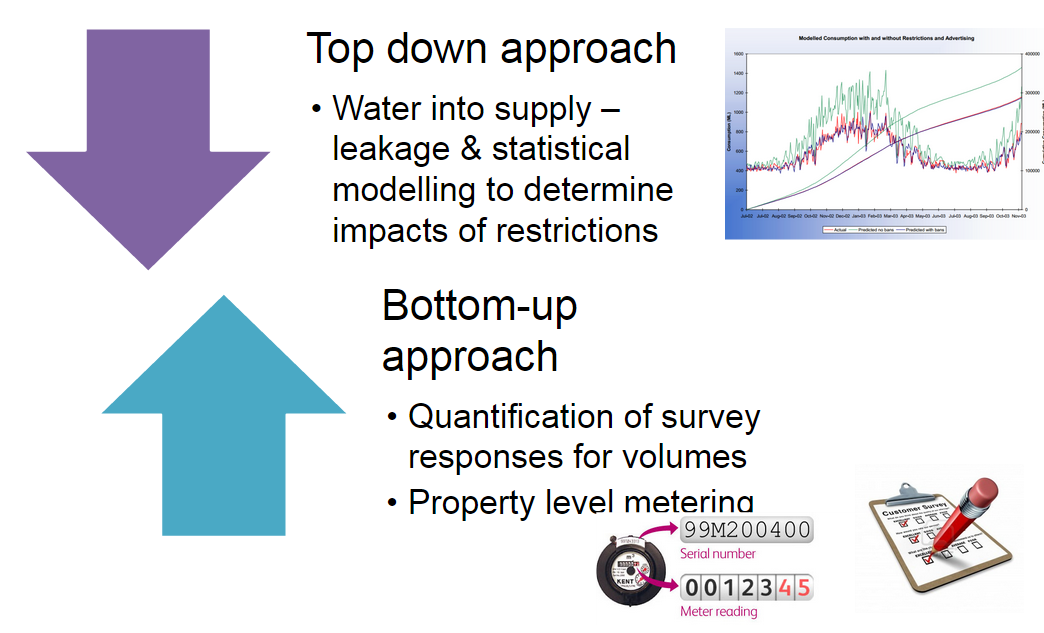
The UKWIR report also identified a range of data gaps and varying levels of detail between water companies. A top down or bottom up assessment of the impacts of TUBs on water use can be undertaken, however due to flooding events while these were in place during the 2012 drought, neither method provided statistically robust trends. In future, companies who record their communications efforts in more detail may find this easier to match with impacts on demand.
Methods to assess changes in water use during a drought


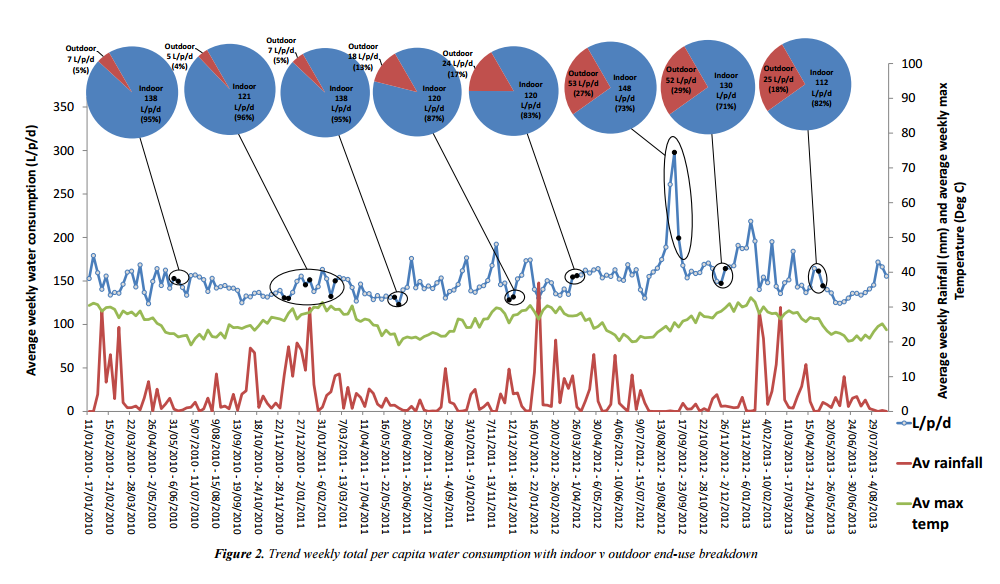
As we move towards higher levels of smart metering we need to consider what this means for evaluating the impacts of actions taken during a drought. For example, better disaggregation of demand components (e.g. toilet, shower, etc.) within smart meter data and real-time analysis could identify the potential vs actual savings in outdoor use but also better target the larger proportion of domestic consumption that is indoor use.


An example for South East Queensland was presented at the IWA Efficient 2013 conference by Cara Beal. Through the residential end use study (bottom-up) they could determine changes in water use in the home linked with levels of watering restriction. A similar longer-term analysis of smart metering data for households in the UK may provide this information to target restrictions in future.

Water consumption trends with internal and external splits highlighted

Major environmental challenges for the water sector

 A quick post on some of the major environmental challenges for the water sector: 1. Climate change – water is a key medium through which we...